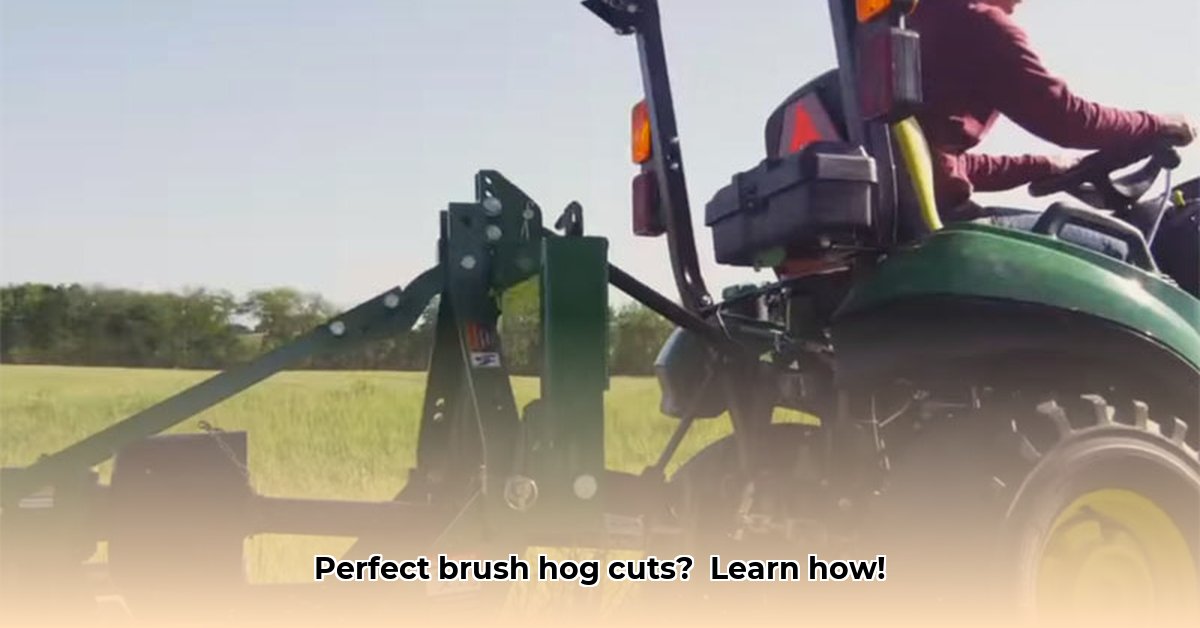
Getting a clean, even cut with your brush hog isn't just about starting the tractor; it's about proper adjustment. A well-adjusted brush hog protects your equipment, makes the job easier, and produces superior results. This guide provides a step-by-step approach, ensuring perfect cuts every time. For more information on brush hog selection, see this helpful guide.
Step 1: Leveling the Cutting Deck (The Foundation for a Perfect Cut)
Before adjusting height, ensure your brush hog's cutting deck is perfectly level. An uneven deck leads to an uneven cut. Use a level (a simple bubble level works) placed across the deck. Adjustment bolts (typically on the deck sides) allow for fine-tuning. Adjust these bolts until the bubble is centered. This seemingly small step is crucial for consistent results. Don't rush; a level deck is foundational.
Step 2: Setting the Overall Cutting Height (Using Your Tractor's Three-Point Hitch)
Your tractor's three-point hitch controls the overall cutting height. Most tractors use levers or hydraulic controls to adjust the lift arms. First, raise the brush hog slightly above your desired cutting height. Then, slowly lower it. Small adjustments significantly impact the cut. A tape measure ensures accuracy. This step sets the baseline; fine-tuning comes later.
Step 3: Fine-Tuning with the Tailwheel (Achieving Precision and Angle)
The tailwheel, at the brush hog's rear, fine-tunes the cutting deck's angle and height. Adjusting this wheel compensates for height differences between the cutter's front and back. Generally, the front should be slightly lower than the rear for smooth material flow and reduced clogging. Experiment with small adjustments, observing how the cut changes. The tailwheel isn't just support; it's key to optimal cutting.
Step 4: Utilizing Check Chains (If Equipped) – Enhancing Safety and Consistency
While modern brush hogs use hydraulic systems, older models often have check chains. These chains prevent the brush hog from lifting too high. Adjustable check chains provide a safety net, preventing accidental damage from excessive lift. Ensure the chains are appropriately sized for your brush hog – too weak, and they're ineffective; too strong, and they can cause problems. Safety always comes first.
Troubleshooting Common Issues
- Scalping: If the brush hog digs into the ground, raise the cutting height. Uneven terrain necessitates frequent adjustments.
- Uneven Cuts: Re-check Step 1; an uneven deck is the most common cause.
- Clogging: Slightly lower the deck's front (Step 3) to improve material flow.
- Inconsistent Height: Double-check all adjustments; a small error can impact the overall result.
Remember, adjusting your brush hog is a skill that improves with practice. Make small adjustments and observe the results. Always disengage the power take-off (PTO) before making any adjustments.
Recommended Cutting Heights
While the ideal height depends on vegetation and terrain, these guidelines offer a starting point:
| Vegetation Type | Recommended Height (inches) |
|---|---|
| Tall grass/weeds | 4-6 |
| Pasture maintenance | 2-4 |
| Fine grass/lawn | 1-2 |
Experiment to find what works best for your situation.
Adjusting for Uneven Terrain: A More Iterative Approach
Mowing uneven terrain requires a more iterative approach. The key is incremental adjustment based on observation.
Step 1: Leveling Remains Crucial
Begin by ensuring the cutting deck is level. This remains the most important single step for an even cut.
Step 2: Mastering Three-Point Hitch Adjustments
The three-point hitch's top link length dictates overall height; for uneven terrain, you'll make tiny adjustments as you go across slopes and varied land.
Step 3: Tailwheel as Your Terrain Compensator
Use the tailwheel to maintain ground contact, particularly on slopes and bumps. Adjust as needed while mowing to achieve the desired cutting pattern.
Step 4: Iterative Adjustments are Key
Start with a higher-than-normal setting, preventing scalping. Constantly monitor and readjust the three-point hitch and tailwheel as you mow. This is a dynamic process, not a static setting.
Advanced Technique: Check Chains for Older Equipment
Older models, lacking precise hydraulic control, benefit significantly from check chains. These constrain the three-point hitch's movement, providing greater stability and consistency in cutting height, especially valuable on slopes.
Remember, consistent, careful observation and iterative adjustments are key to mastering brush hog setup for consistently clean cuts, regardless of terrain.